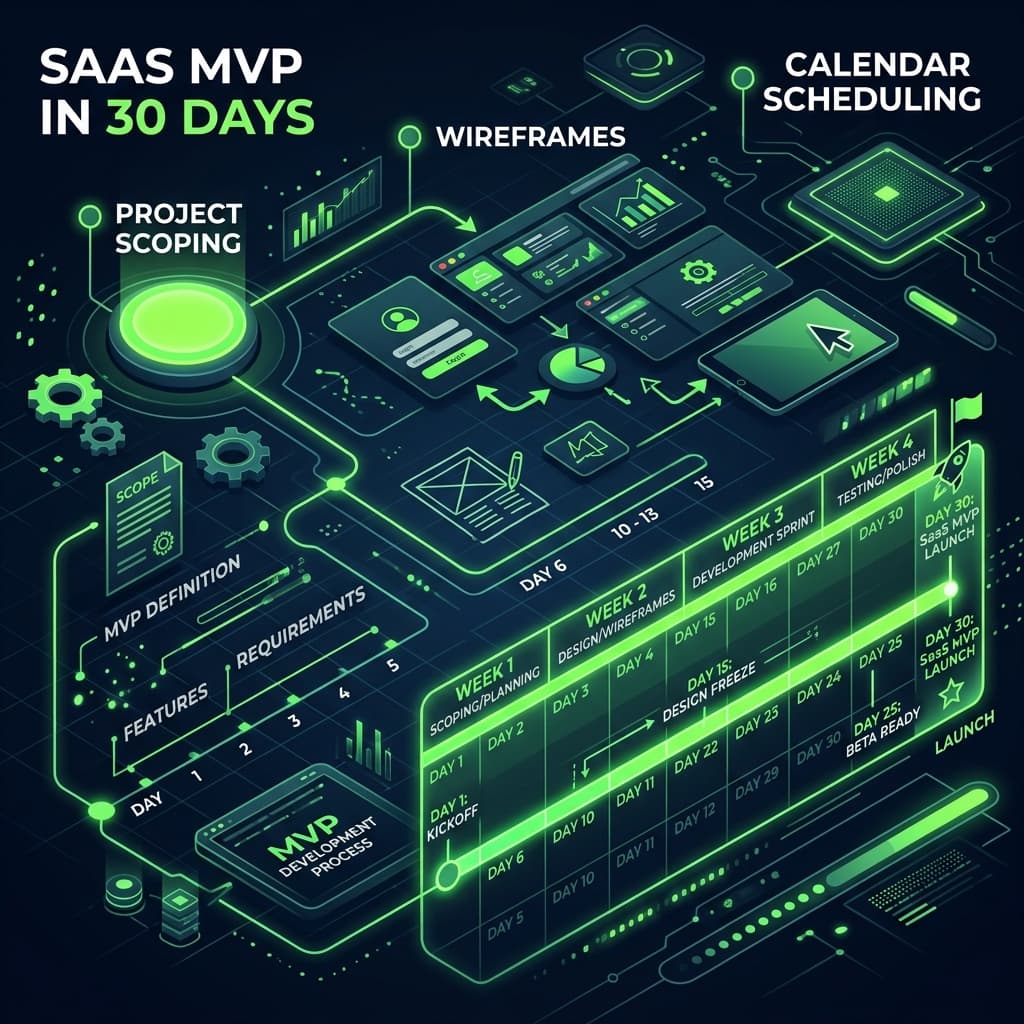
Launch in 30 Days: The Scoping Framework for SaaS MVPs
To launch a SaaS MVP in 30 days, you must adopt a strict SaaS MVP scoping framework that freezes the database schema by Day 10, limits third-party API integrations to critical paths (Stripe and Auth), and uses a rigid MOSCOW model to drop any features that do not directly validate your core value proposition. Focus on a single user type, one core workflow, and a simple checkout path. Any feature that can be handled manually in a spreadsheet must be deferred to post-launch iterations.
For startup founders, building a product is an emotional journey. It is easy to fall into the trap of "just one more feature." However, every extra feature increases complexity, introduces bugs, and delays validation. Partnering with a consultant like a bhalli software consulting MVP expert ensures your scoping remains disciplined, keeping your product on track for a fast, budget-compliant market launch.
1. The MOSCOW Prioritization Matrix
The foundation of a 30-day MVP is the MOSCOW prioritization framework:
- Must Have: Crucial features without which the product cannot function (e.g., auth, billing, core value dashboard).
- Should Have: Important features that can be worked around manually or post-launch (e.g., automated email notifications, advanced filter inputs).
- Could Have: Nice-to-have features that do not impact the core loop (e.g., dark mode toggle, team role permissions, detailed PDF reports).
- Won't Have: Out-of-scope items completely deferred to future versions (e.g., native mobile apps, custom analytical AI model training).
Scoping the Core User Loop
To write a functional product spec, map out the absolute shortest path a user can take to solve their problem. For example, if you are building an AI-powered invoice parser:
- Core Loop: Sign up -> Upload PDF -> View parsed JSON -> Download CSV.
- Out of Scope: Invoice sharing, dynamic PDF editor, multi-currency conversion dashboards, team Slack alerts.
2. Technical Boilerplates & Rapid Integration
To deliver an MVP in 30 days, you cannot build everything from scratch. You must utilize premium boilerplates for authentication, database mapping, and payments. We recommend using Next.js App Router for the frontend/backend API routes, Supabase or Prisma/PostgreSQL for the datastore, and Stripe for billing.
Below is a production-grade React hook designed to fetch a Stripe checkout session from a Next.js API route and handle redirect flows securely. This minimizes billing setup complexity to a single day:
// src/hooks/useStripeCheckout.ts
import { useState } from 'react';

interface CheckoutOptions {
  priceId: string;
  userId: string;
}

export function useStripeCheckout() {
  const [loading, setLoading] = useState(false);
  const [error, setError] = useState<string | null>(null);

  const triggerCheckout = async ({ priceId, userId }: CheckoutOptions) => {
    setLoading(true);
    setError(null);

    try {
      const response = await fetch('/api/billing/checkout', {
        method: 'POST',
        headers: { 'Content-Type': 'application/json' },
        body: JSON.stringify({ priceId, userId }),
      });

      if (!response.ok) {
        throw new Error('Failed to initiate checkout session');
      }

      const { url } = await response.json();
      if (url) {
        window.location.href = url; // Redirect to Stripe Hosted Checkout
      } else {
        throw new Error('No checkout URL returned from gateway');
      }
    } catch (err: any) {
      setError(err.message || 'An error occurred during billing checkout');
      setLoading(false);
    }
  };

  return { triggerCheckout, loading, error };
}
This Stripe hook redirects users to a secure checkout portal hosted by Stripe, eliminating the need to design complex billing pages, credit card validation fields, or compliance flows locally.
Ensuring Data Integrity with Strong Validation
In a rapid MVP build, the database can easily get corrupted if inputs are not validated strictly at the API gateway layer. We implement schema validation using Zod on every endpoint. Below is an API route snippet demonstrating how to validate user input securely using Zod in Next.js:
// src/app/api/onboarding/route.ts
import { NextRequest, NextResponse } from 'next/server';
import { z } from 'zod';

// Define strict validation schema
const OnboardingSchema = z.object({
  companyName: z.string().min(2, 'Company name must be at least 2 characters').max(50),
  industry: z.enum(['technology', 'finance', 'healthcare', 'retail', 'other']),
  teamSize: z.number().int().min(1).max(10000),
  agreedToTerms: z.literal(true, {
    errorMap: () => ({ message: 'You must accept the terms of service' }),
  }),
});

export async function POST(req: NextRequest) {
  try {
    const body = await req.json();

    // Validate input payload
    const parsedData = OnboardingSchema.safeParse(body);

    if (!parsedData.success) {
      return NextResponse.json(
        { error: 'Validation failed', details: parsedData.error.flatten() },
        { status: 400 }
      );
    }

    const { companyName, industry, teamSize } = parsedData.data;

    // TODO: Write onboarding data to PostgreSQL database via Prisma

    return NextResponse.json(
      { success: true, message: `Company ${companyName} onboarded successfully` },
      { status: 201 }
    );
  } catch (err: any) {
    return NextResponse.json(
      { error: 'Invalid payload structure' },
      { status: 400 }
    );
  }
}
By enforcing strict boundaries with Zod, we eliminate database injection vulnerabilities and logic bugs, protecting your product as it scales.
3. Structural Comparison: Feature Scoping Blueprint
Here is an objective comparison of what should be included in a 30-day MVP vs. what should be deferred to a later date:
| Feature Area | Included in 30-Day MVP | Deferred to V2 (Post-Launch) |
|---|---|---|
| Authentication | Magic Link or standard Email/Password | Multi-factor (MFA), SAML SSO, social providers |
| Payment Gateway | Stripe pre-built Checkout session page | Custom Stripe Elements inline billing UI |
| Database Structure | Flat tables, basic relational structure | Microservices databases, custom analytics data lake |
| User Support | Embedded Chat Widget (Hubspot/Intercom) | Custom ticket support center, admin agent chat |
| System Testing | Core API unit tests, critical user paths | Full E2E cypress test suites, performance trace audits |
| Notifications | Direct Transactional Emails (Nodemailer) | Complex in-app real-time activity feed, SMS triggers |
4. Real-World Trade-Offs and Budget Considerations
When scoping your MVP, you must prioritize cash runway over architectural perfection. A common pitfall is allocating 80% of the budget to infrastructure scaling (like Kubernetes, Redis clusters, or complex AWS setups) before having a single paying customer.
The Lean Infrastructure Model
For a launch-ready MVP, deploy your Next.js application on a serverless provider (such as Vercel or Netlify) and host your database on a managed cloud platform (like Supabase, AWS RDS, or Neon). This keeps your hosting costs near $0/month during validation, allowing you to reallocate budget towards marketing, customer discovery, and product iterations.
5. Contact BhalliSoft to Scoping Your Project Today
At Bhalli Software Solutions, we specialize in cutting through feature noise. We help technical founders and startups launch fast, responsive, and secure SaaS products within deterministic 30-day timelines.
Are you ready to turn your product concept into a launchable SaaS MVP?
Book a Free MVP Scoping Session with BhalliSoft to receive a custom architecture specification sheet, database structure layout, and a fixed-timeline 30-day execution roadmap. Let's launch your product.