When to Migrate MERN Monolith to Microservices: SaaS MVP Scaling Blueprint
Deciding when to migrate MERN monolith to microservices comes down to three operational triggers: when your database connection pool saturates under independent service loads, when deployment cycles block cross-functional engineering teams, or when API latency degrades beyond an SLA budget due to monolithic CPU bottlenecks. If you are experiencing these limits, migrating isolated domains (such as auth or billing) to microservices is justified; otherwise, maintaining a well-structured modular monolith is the most cost-effective path.
As a startup founder or technology director, timing this architectural shift is critical. A premature migration will drain your capital and halt your product iterations, while waiting too long can lead to service degradation and team engineering gridlock. Partnering with a seasoned consultant like a bhalli full stack software consultant or a bhalli technology consulting MVP expert helps you determine the precise inflection point using real-world engineering telemetry rather than hype.
1. The Monolith-to-Microservices Latency Equation
When you transition from a single monolithic node to a distributed architecture, communication shifts from in-memory function calls to network calls. This introduces latency overhead. Every network hop adds serialization, deserialization, network transit, and handshake time.
Before migrating, you must calculate your projected distributed latency to ensure it fits within your SLA budgets:
If your query patterns require chaining requests across four distinct services, your latency accumulates linearly. If the result exceeds your budget, you must optimize service boundaries or adopt asynchronous event-driven queues.
Calculating Network Hops in a Distributed System
Consider a monolithic MERN application where a single API call to GET /api/v1/orders/checkout queries the DB twice, performs in-memory validation, and returns. In a monolithic system, this function call takes ~15ms + database query times.
Now, imagine we decompose this into three microservices:
- API Gateway (handles rate limiting and JWT verification)
- Order Service (orchestrates the order state machine)
- Inventory Service (tracks stock levels)
The sequence of network calls now looks like this:
Client ──[HTTP/2]──> Gateway ──[gRPC]──> Order Service ──[gRPC]──> Inventory Service
If each gRPC connection over a local virtual network averages 2.5ms, and the HTTP request adds 10ms of SSL/TLS negotiation, we have introduced a net overhead of 15ms purely in transport cost. If your database queries are poorly optimized, this network latency compounding can easily degrade your Lighthouse Performance score.
To mitigate this transport latency, we implement high-speed API Gateways and Edge-optimized rate limiters. Below is a production-ready Next.js middleware snippet demonstrating how to implement a token-bucket rate limiter at the gateway layer to protect downstream microservices:
// src/middleware/rateLimiter.ts
import { NextResponse } from 'next/server';
import type { NextRequest } from 'next/server';

interface RateLimitStore {
  tokens: number;
  lastRefill: number;
}

const LIMITER_CACHE = new Map<string, RateLimitStore>();
const BUCKET_CAPACITY = 100;
const REFILL_RATE = 10; // 10 tokens per second

export async function rateLimiterMiddleware(req: NextRequest) {
  const ip = req.ip || req.headers.get('x-forwarded-for') || '127.0.0.1';
  const now = Date.now();

  let record = LIMITER_CACHE.get(ip);
  if (!record) {
    record = { tokens: BUCKET_CAPACITY, lastRefill: now };
  } else {
    // Calculate tokens to add based on elapsed time
    const elapsedSeconds = (now - record.lastRefill) / 1000;
    const tokensToAdd = Math.floor(elapsedSeconds * REFILL_RATE);
    record.tokens = Math.min(BUCKET_CAPACITY, record.tokens + tokensToAdd);
    record.lastRefill = now;
  }

  if (record.tokens <= 0) {
    return new NextResponse(
      JSON.stringify({ error: 'Too Many Requests', retryAfter: 1 }),
      { status: 429, headers: { 'Content-Type': 'application/json' } }
    );
  }

  // Consume 1 token for the request
  record.tokens -= 1;
  LIMITER_CACHE.set(ip, record);

  const res = NextResponse.next();
  res.headers.set('X-RateLimit-Limit', BUCKET_CAPACITY.toString());
  res.headers.set('X-RateLimit-Remaining', record.tokens.toString());
  return res;
}
This gatekeeper pattern ensures that malicious or runaway clients are blocked at the perimeter before consuming precious internal network bandwidth.
2. Structural Topology: Healthy vs. Unhealthy Isolation
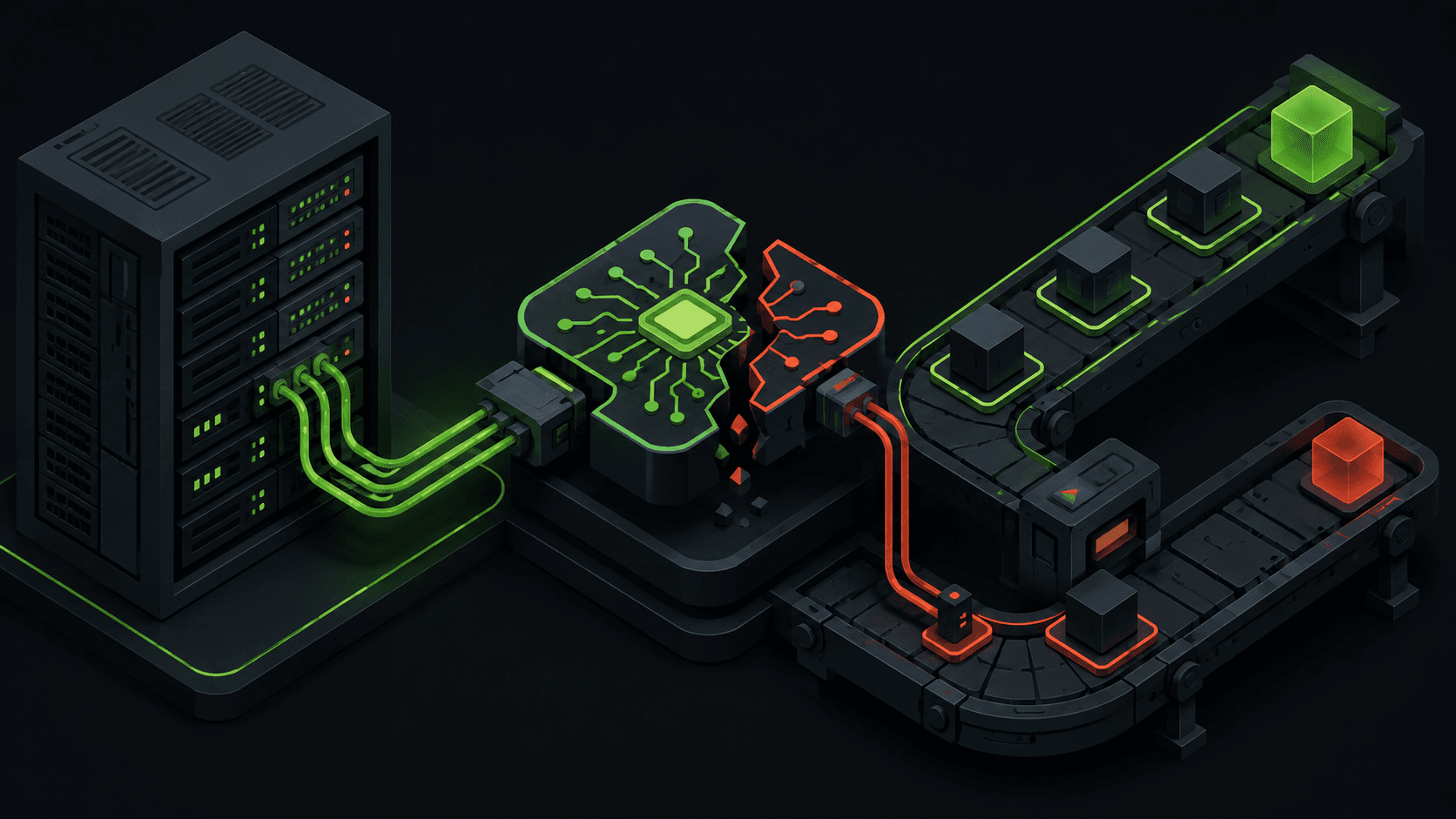
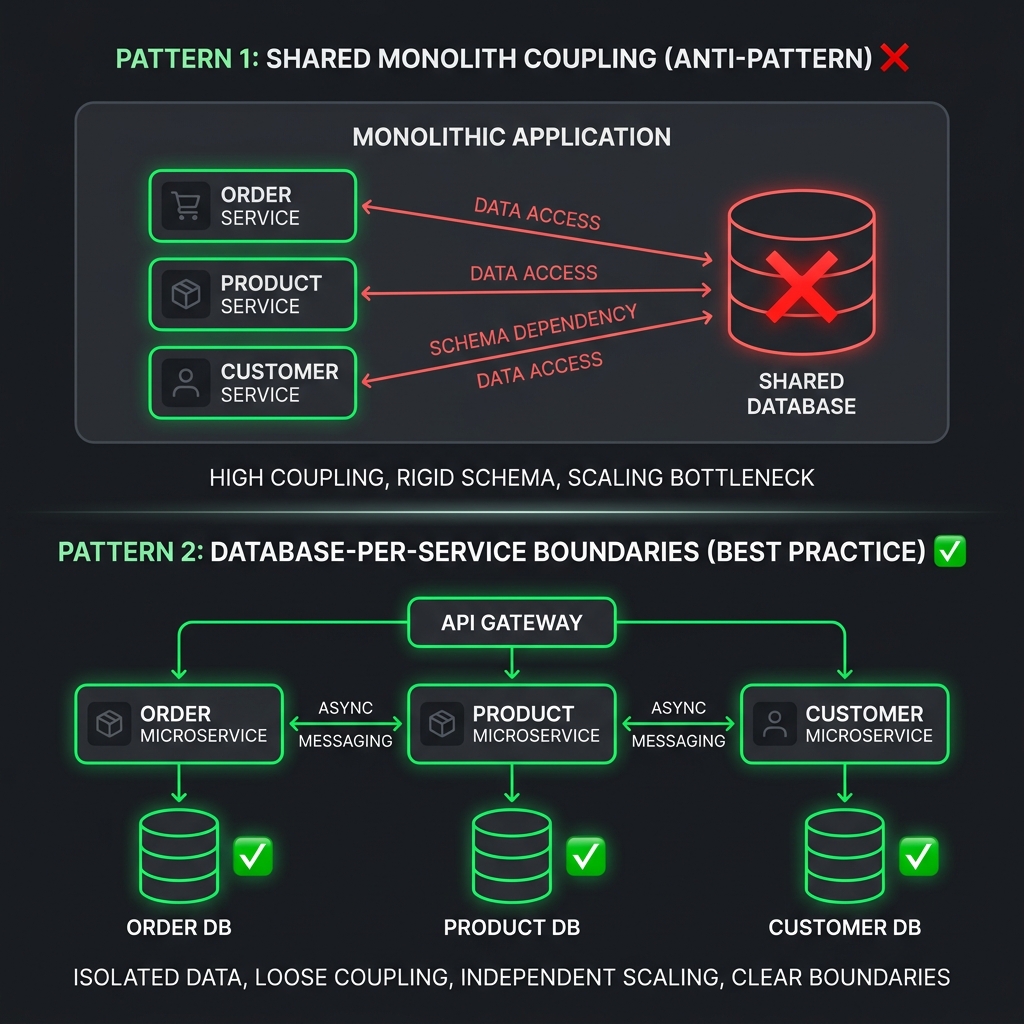
A common failure in microservices migrations is "distributed monolith" coupling. This occurs when services are split logically, but share a single, monolithic database behind the scenes. This is a severe anti-pattern that creates the worst of both worlds: the operational complexity of microservices coupled with the tight dependency mapping of a monolith.
To verify your separation boundaries, inspect the database architecture.
The Database-per-Service Paradigm
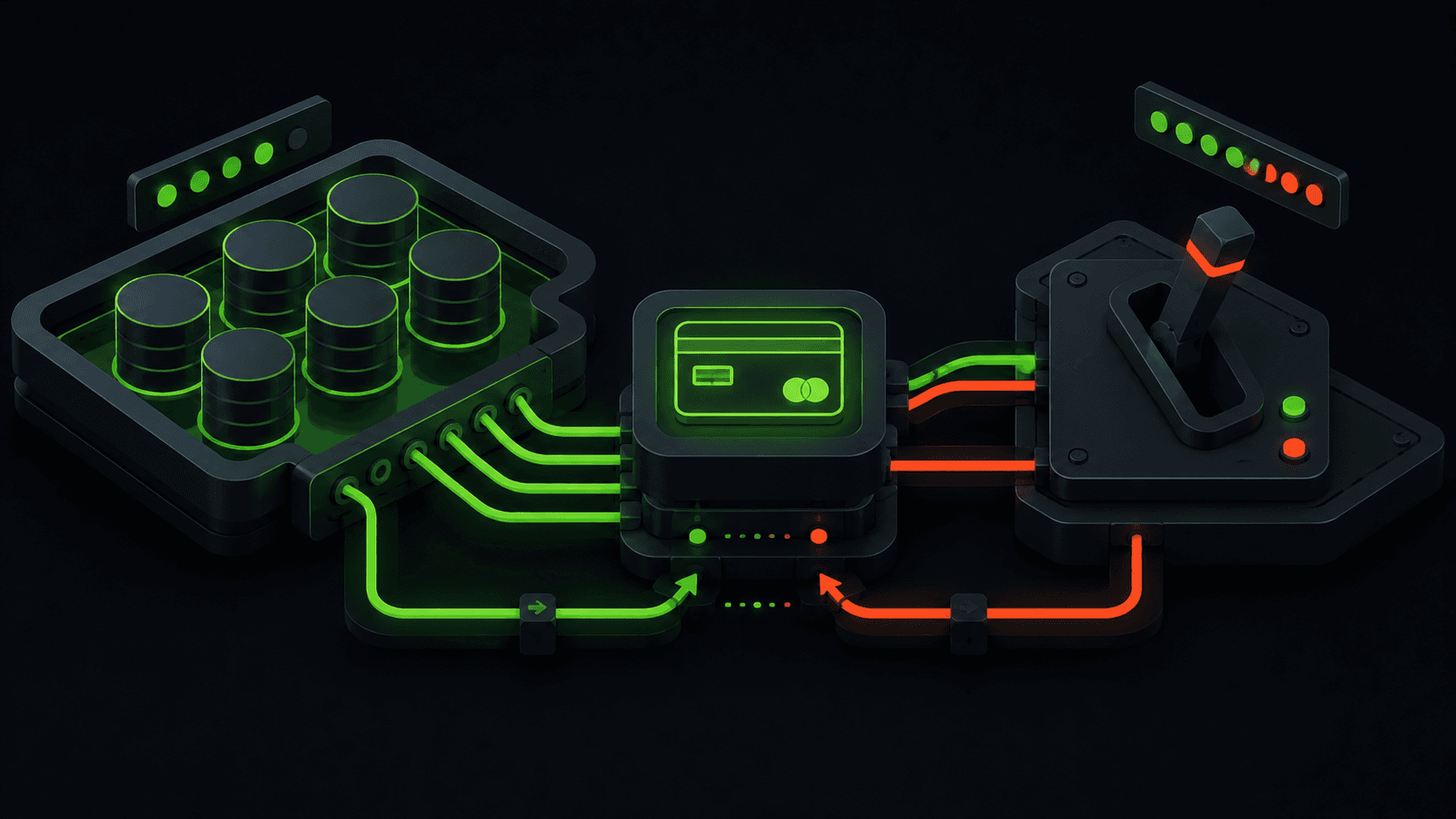
In a true microservices setup, each service owns its datastore. No external service is allowed to query another service's database directly. Communication occurs exclusively over typed API routes (REST, gRPC) or event brokers (Kafka, RabbitMQ) with strict schema boundaries.
Let's review a Next.js API route that interacts with an isolated microservice endpoint rather than querying a shared MongoDB database directly. This isolates database driver pooling and ensures schema changes in the Order Database do not break the UI checkout flow:
// src/app/api/orders/route.ts
import { NextRequest, NextResponse } from 'next/server';

const ORDER_SERVICE_URL = process.env.ORDER_SERVICE_INTERNAL_URL || 'http://orders-service.internal.local';

export async function POST(req: NextRequest) {
  try {
    const payload = await req.json();

    // Validate request structure
    if (!payload.items || payload.items.length === 0) {
      return NextResponse.json({ error: 'Missing checkout items' }, { status: 400 });
    }

    // Call downstream microservice via internal network interface
    const response = await fetch(`${ORDER_SERVICE_URL}/v1/orders`, {
      method: 'POST',
      headers: {
        'Content-Type': 'application/json',
        'Authorization': `Bearer ${process.env.INTERNAL_SERVICE_TOKEN}`,
      },
      body: JSON.stringify(payload),
    });

    if (!response.ok) {
      const errorMsg = await response.text();
      return NextResponse.json(
        { error: 'Checkout failed', details: errorMsg },
        { status: response.status }
      );
    }

    const orderData = await response.json();
    return NextResponse.json({ success: true, orderId: orderData.id }, { status: 201 });
  } catch (error: any) {
    return NextResponse.json(
      { error: 'Internal gateway connection failure', message: error.message },
      { status: 502 }
    );
  }
}
This decoupled routing layer ensures that if the Order Service goes offline, the rest of the application (such as Product browsing or User authentication) remains fully functional.
3. Structural Comparison: Monolith vs. Microservices
To make a rational business decision, we must analyze the trade-offs of both approaches side-by-side:
| Architectural Metric | Monolithic MERN Stack | Microservices Architecture |
|---|---|---|
| Initial MVP Dev Speed | Ultra-Fast (1-2 devs, single repo) | Slow (needs API gateways, pipelines) |
| Operational Overhead | Low (Single deployment container) | High (Multiple pipelines, orchestration) |
| Fault Isolation | Poor (One crash takes down all routes) | Excellent (Failing service is isolated) |
| Deployment Independence | None (Entire app redeploys at once) | Full (Each service deploys independently) |
| Data Integrity | High (Relational ACID transactions) | Complex (Distributed transactions, Saga pattern) |
| Compute Scaling | Vertically (Scaling the entire monolith) | Horizontally (Scale individual bottlenecks) |
4. When Is Your SaaS Ready for Microservices?
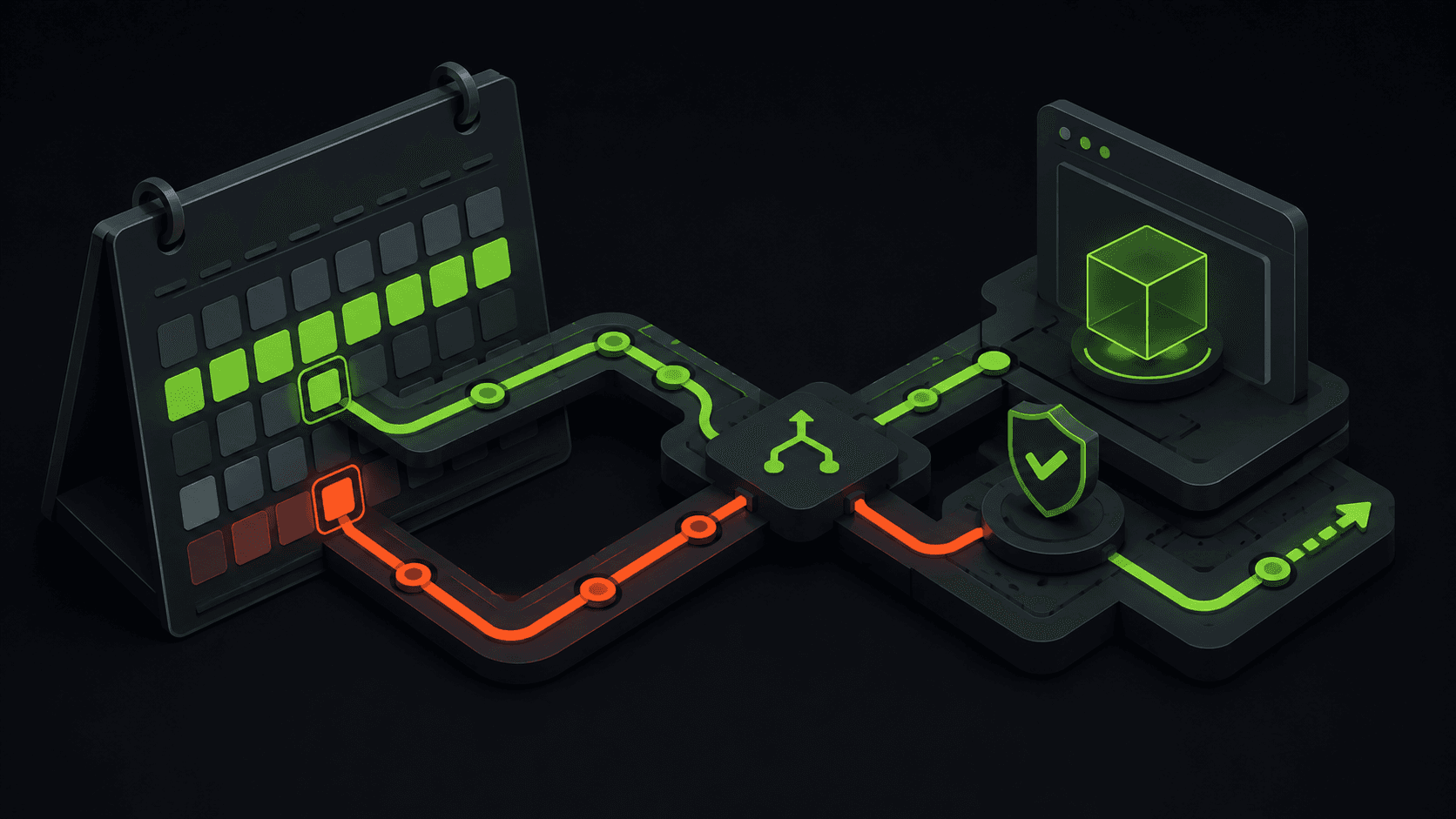
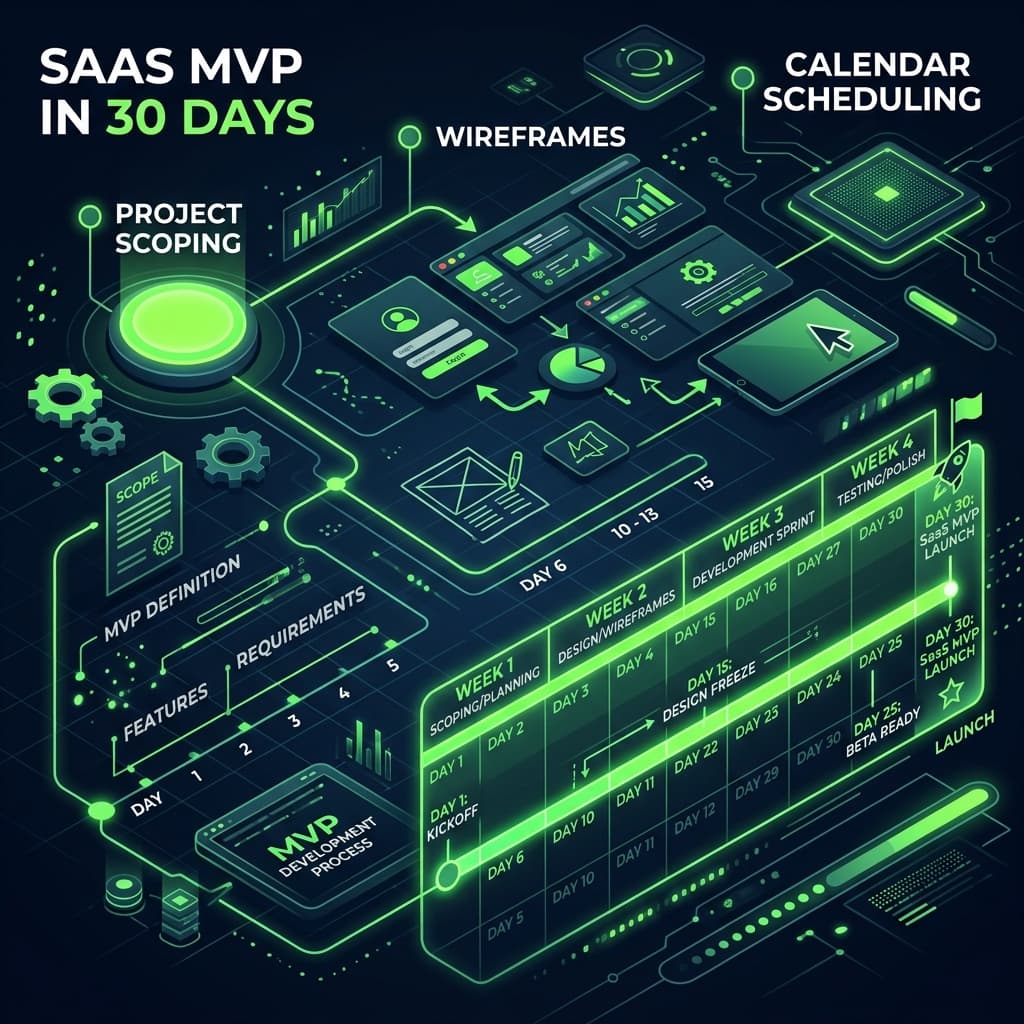
We advise clients to utilize the MOSCOW method to scope their MVP features inside strict 30-day boundaries. Do not rewrite the entire system. Instead, extract your highest-load services first (e.g., auth, payment processing) to isolate compute resources.
The Inflection Checklist
Ask yourself these four questions before planning your microservices migration:
- Is your development team larger than 10-15 engineers? If you have fewer than 10 developers, the communication overhead of microservices will slow down your feature output.
- Do you have isolated scaling needs? For example, is your image-processing module consuming 90% of your monolithic CPU and starving your simple API text-query routes?
- Do you have automated CI/CD and DevOps pipelines established? If you still deploy manually or lack robust end-to-end testing, managing 5-10 services will become a operational nightmare.
- Is your code domain-coupled? If your codebase is a "spaghetti" monolith where databases are coupled with cross-imports, you must refactor the monolith into clean modules first before attempting to decouple them physically.
When you need an experienced leader to design these high-availability distributed systems, hiring an expert from Bhalli Software Solutions ensures your architecture is built right from day one.
5. Summary & Next Steps
Migrating a MERN monolith to microservices is a technical investment that must yield measurable business returns. Focus on database boundaries, calculate your network latency overhead, and ensure your team has the infrastructure capacity to manage a distributed system.
Are you looking to scale your startup's MVP, or do you need a robust, high-availability architecture audit?
Book a Free Technical Strategy Session with BhalliSoft to discuss your product roadmap, optimize your Next.js frontend performance, or implement enterprise-grade AI integrations. Let's build a product that scales with your growth.